
Agriculture
Natural Capital Degradation
Agriculture is the largest industry and is also the most harmful to the environment. Many of the effects harm the air, water, soil, and biodiversity. Crop yields may go down soon due to many environmental factors.
Soil
Erosion is the movement of soil from one place to another by water and wind. A lot of the soil that is moved is the surface litter and topsoil. Topsoil is the fertile part of soil and without topsoil plants won't be able to grow. Topsoil is a naturally renewable resource. However, it takes many decades to hundreds of years to be about to replenish 2.5 centimeters of topsoil. When topsoil erodes faster than it forms it becomes a nonrenewable resource. Soil erosion causes the loss of soil fertility through the depletion of plant nutrients of topsoil. Erosion also causes water pollution in nearby surface waters. The eroded soil ends up as sediment which kills fish and shellfish and clogs up irrigation ditches, boat channels, reservoirs, and lakes.
Types of Erosion
Sheet erosion happens when wind or surface water peels of thin sheets of soil. SInce the topsoil dissapears evenly, years may go by before it is noticeable that all of or most of the topsoil is gone.
Rill erosion happens when fast flowing rivulets of surface water make small channels in the soil.
Gully erosion happens when fast flowing rivulets of water join together and make wider and deeper ditches. Severe gully erosion happens on steep slopes where there is little to no vegetation.

Sheet Erosion

Rill Erosion

Gully Erosion
Salinization
Salinization is the accumulation of salts in upper soil layers. This happens because irrigated water is a dilute solution of various salts which are picked up as the water flows over or through soil and rocks. Some of the irrigation water isn't absorbed into the soil before the water evaporates, so salts are left behind in the topsoil. Salination stunts plant growth, lowers crop yields, kills plants, and ruins the land. Salination can also occur naturally in areas where the parent material is rich in carbonates and sulfate minerals and in areas where it is arid or semiarid. Estimates were made by the UN that about 1/5 of the world's cropland was severely salinized and 1/3 of the world's cropland was moderately salinized. Asia is where most of the severe salination occurs, especially in India, China, and Pakistan. 1/4 of the United States irrigated cropland is affected by salination, especially in the western states.
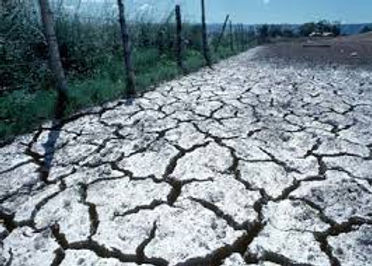
Waterlogging
Waterlogging occurs when farmers try and use too much irrigation water to try and leach the salts deeper into the soil. When the water isn't able to drain well, water accumulates underground and the water table will rise. The saline water envelops the deep roots of plants which will lower their productivity and after prolonged exposure the plants will die. At least 1/10 of the world's irrigated cropland is waterlogged and the problem is getting worse.

Desertification
Desertification occurs when the productive potential of drylands in arid and semiarid areas fall by 10% or more due to a combination of human activities that reduce or degrade topsoil and natural climate change that causes prolonged drought.
Moderate (10-25% drop in productivity)
Severe (25-50% drop in productivity)
Very Severe (a drop in productivity greater than 50% creates large gullys and dunes)
Only in extreme cases does severe desertification create a desert. Severe desertification can expand existing desert area and can create new desert land where there was once fertile land. About 1/3 of the world's land and about 70% of the world's dryland are suffering from desertification. We can reduce overgrazing, deforestation, and destructive forms of planting, irrigation, and mining that leave behind barren soil. We can also restore the land by planting trees and grasses that hold water and keep soil in place, establish windbreaks, and grow plants and trees together.


Biodiversity Loss
In order to make room for all the fields and cropland forests, grasslands, and wetlands are cleared so that there is more land that can be used to plant crops and the land is depleted.
Sediments that end up in the water from soil erosion can kill fish. Runoff from pesticide can also kill fish.
Predators like wolves are killed off by ranchers that want to protect their livestock.
There is less genetic diversity of wild crop strains because a lot of agriculture is a monoculture so there isn't any different varieties.

Water
A lot of farmers sren't using efficient ways to irrigate their crops so a lot of water is wasted.
We are using up water from aquifers 4 times faster than what an aquifer's recharge rate is to irragate crops in dry areas.
When an area of land is cleared there is an increased amount of runoff and flooding. When there is runoff from pesticides it can kill the fish.
Erosion will cause sediments to get into the water which will pollute the water.
Surface and groundwater can become polluted from pesticides and fertilizer.
Lakes and rivers can become overfertilized from fertilizers, livestock wastes, and food processing wastes. The overfertilization can cause algae blooms. When the algae blooms die bacteria will break down the algae. It will take a lot of oxygen to break down the algae and the dissolved oxygen levels will be depleted.
Air Pollution
Greenhouse gases are emmited into the atmosphere since there is a lot of fossil fuel used to operate the machines, process the food, and transport it across countries. Other pollutants are also in the air due to fossil fuel use.
Cows release a lot of the greenhouse gas methane when they belch.
Pesticide sprays pollute the air.
